Quick answers
What is the strongest psilocybin mushroom?
Psilocybe azurescens is the most potent known Psilocybe species, measuring 1.18–1.78% psilocybin by dry weight (Stamets & Gartz, 1995). Among P. cubensis cultivars, Albino Penis Envy and Tidal Wave test highest.
How does Golden Teacher compare to Penis Envy?
Golden Teacher averages 0.63–0.76% total tryptamines. Penis Envy commonly tests 1.0–2.0%+, making it roughly 2–3× more potent by gram. Reduce your usual dose by 50% when switching to PE for the first time.
Was the 3.82% Tidal Wave result real?
Yes — but it came from a non-sporulating Tidal Wave "Enigma" blob mutation submitted to the Fall 2021 Oakland Hyphae Cup, not standard fruiting bodies. Typical Tidal Wave tests 1.0–1.4%.
Are "albino" mushroom strains more potent?
Most albino P. cubensis are technically leucistic (reduced pigment, dark spores — not true albinos). They generally test higher than their pigmented parents, but no peer-reviewed head-to-head comparison exists. Community Cup data supports the trend.
What is Wood Lover's Paralysis?
A temporary leg weakness or paralysis reported by some users of wood-loving Psilocybe species (azurescens, cyanescens, subaeruginosa). A 2025 Toxicon study found 42.1% of surveyed users reported it. The causative compound is unidentified.
At a glance
All 12 strains compared
| Strain | Species | Potency (dry wt.) | Tier | Jump to |
|---|---|---|---|---|
| Golden Teacher | P. cubensis | ~0.63–0.76% | Classic | → Golden |
| B+ | P. cubensis | ~1.11% (mean) | Classic | → B+ |
| Mazatapec | P. cubensis | ~0.55–0.65% | Classic | → Mazatapec |
| Truffle (Atlantis) | P. atlantis | ~0.3–0.8% dry | Classic | → Truffle |
| Albino A+ | P. cubensis | ~0.85–1.10% | Above Average | → Albino |
| Albino Avery | P. cubensis | ~0.80–0.95% | Above Average | → Albino |
| Albino Treasure Coast | P. cubensis | ~0.85–1.10% | Above Average | → Albino |
| Blue Meanie | P. cubensis | ~1.18% (mean) | Above Average | → Blue |
| Tidal Wave | P. cubensis | ~1.0–1.4% | High Potency | → Tidal |
| Penis Envy | P. cubensis | ~1.0–2.0%+ | High Potency | → Penis |
| Albino Penis Envy | P. cubensis | ~1.4–1.8%+ | High Potency | → Albino |
| P. azurescens | P. azurescens | 1.18–1.78% | Wild Species | → P. |
Potency figures from: Beug & Bigwood 1982 · Stamets & Gartz 1995 · Pellegrini et al. 2013 · PMC11856550 (2025) · Oakland Hyphae Psilocybin Cup 2021–2022. Cup data reflects self-selected grower submissions and skews toward the upper end of actual distribution.
On potency numbers
Percentages are % psilocybin by dry weight. Peer-reviewed data is labelled. Oakland Hyphae Cup data represents best-submitted samples, not population averages — real-world variation is wide.
On "albino" strains
Most albino P. cubensis strains are technically leucistic — reduced pigmentation, but still dark-coloured spores. True albinos produce white spores. We use the common names throughout but flag this distinction.
On strain identity
Cultivar names are not protected or regulated. A strain sold as "Golden Teacher" may vary significantly between growers. Our dosage calculator uses conservative potency midpoints for this reason.
Which Strains Are Classic Potency?
~0.55–0.76% psilocybin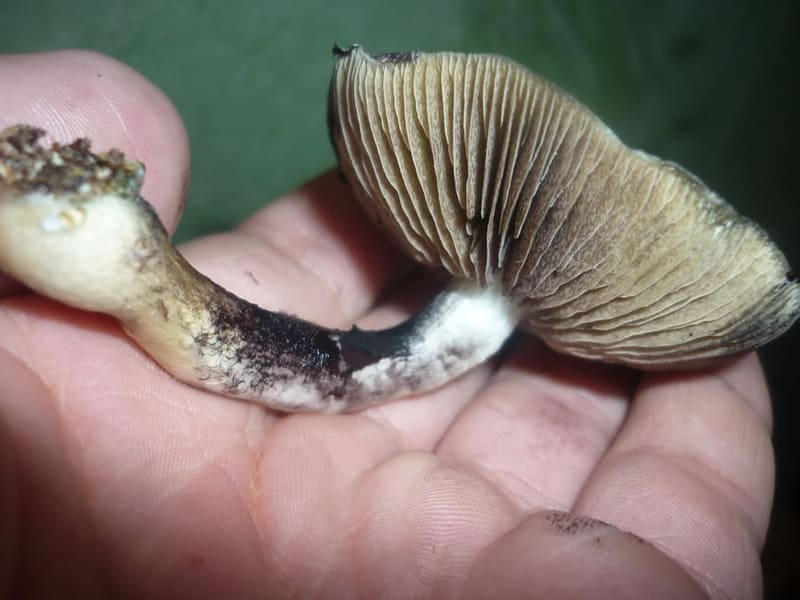
AirGrib, CC0 Public Domain — Wikimedia Commons
Golden Teacher
Origin & History
Golden Teacher first appeared in commercial cultivation in the late 1980s. Its precise origin is undocumented — likely Florida or Georgia based on forum records, but no confirmed wild collection exists. The name references both the characteristic golden-caramel cap colour and the strain's reputation for producing what growers describe as "insightful" experiences. It became the reference cubensis cultivar; when people say "shrooms," they usually mean something close to this.
Morphology
Caps range 4–8cm at maturity, broadly convex to almost flat with a distinctive amber-gold centre that lightens toward the edge. Gills are broadly attached, pale grey when young, darkening to purple-black with spore maturation. Stems are 8–15cm, thick, white with a persistent skirt-like annulus. One of the more photogenic cubensis cultivars.
Effects & Character
Users consistently describe Golden Teacher as even-tempered — gentle ascent, reliable duration (4–6 hours), and a character that leans toward introspection and warmth rather than intensity. Visuals at standard doses are mild to moderate: colour enhancement, subtle pattern overlays. Body-load is minimal. It remains the most common beginner strain specifically because it is forgiving: underdosing it is uneventful, and overdosing it is rarely described as overwhelming.
Potency Data
No strain-specific peer-reviewed assay for Golden Teacher exists. Community Psilocybin Cup data suggests an average around 0.63–0.76% total tryptamines. The 2025 PMC review (PMC11856550) of P. cubensis strains does not include GT in its direct assay table. Potency varies meaningfully between flushes and batches (Bigwood & Beug, 1982, found >7× variation between same-species collections).
Dosing Notes
Because GT is the benchmark, the dosage calculator uses it as the reference point. Most potency tables are normalised against GT. At our estimated 0.70% midpoint, 1g dry = 7mg psilocybin. A 3.5g recreational dose delivers approximately 24.5mg — well within the range used in clinical psilocybin studies (Johnson et al., 2011, used 30mg synthetic psilocybin).
Calculate your Golden Teacher dose
Open Calculator →B+
Origin & History
B+ was developed by a Florida cultivator identified in community records as "Mr. G" — not "Mr. B" as occasionally cited in vendor copy; the latter appears to be a corruption of the original record. The origin is early-to-mid 1990s, Florida. Some sources claim it is a P. cubensis × P. azurescens cross — this has never been scientifically validated and is genetically implausible given the species' different genetic architectures.
Morphology
B+ produces notably large fruiting bodies — caps regularly reach 8–12cm with a broad, shallow cone shape. Colour runs pale tan to caramel with a darker umbo. The veil is substantial and persistent. Yields are consistently high across multiple flushes, which is the main reason this strain dominated the hobbyist cultivation market for two decades.
Effects & Character
The common characterisation — warm, body-positive, "friendly" — holds up consistently across user reports. Visuals are less geometric than some strains, tending toward colour richness and environmental animation rather than closed-eye pattern work. The experience plateaus well and doesn't tend toward sharp peaks. Duration is standard: 4–5 hours at recreational doses.
Potency Data
A 2025 peer-reviewed review (PMC11856550) measured B+ at 11.1 ± 2.5 mg/g psilocybin by HPLC — approximately 1.11%, which is meaningfully higher than most Golden Teacher estimates. The ± 2.5 standard deviation is notable: it reflects genuine within-cultivar variation, not just measurement error. Beug & Bigwood (1982) demonstrated this kind of variation is inherent to P. cubensis regardless of strain label.
Dosing Notes
The PMC 2025 assay data suggests B+ may run slightly hotter than GT. Users accustomed to Golden Teacher at a given gram weight may find B+ slightly more intense. The dosage calculator accounts for this with a slightly elevated potency estimate.
Calculate your B+ dose
Open Calculator →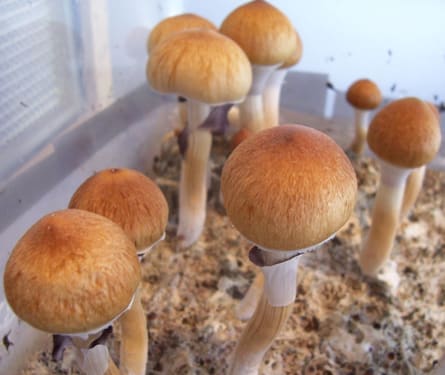
Wowbobwow12, CC BY-SA 3.0 — Wikimedia Commons
Mazatapec
Origin & History
Mazatapec takes its name from the Mazatec people of Oaxaca, Mexico, and is one of the few P. cubensis cultivars with a documented geographic origin. The Mazatec have used psilocybin mushrooms (called teonanácatl in Nahuatl) in ceremonial healing contexts for generations. Their practices were brought to Western awareness when R. Gordon Wasson attended a ceremony with healer María Sabina in Huautla de Jiménez in 1955, publishing his account in Life magazine in 1957.
An important distinction: Sabina's primary ceremonial mushroom was Psilocybe caerulescens (Landslide mushroom), not P. cubensis. The Mazatapec strain (P. cubensis) is named for the cultural and geographic region, not as a direct descendent of Sabina's specific rites. Any framing of Mazatapec as "the Maria Sabina mushroom" is a category error.
Effects & Character
Users describe Mazatapec as earthy, grounding, and more introspective than visual. The experience is often characterised as "clear-headed" — fewer competing thoughts, more spaciousness. Body sensation is warm and light. It's slower-colonising and somewhat lower-potency than GT, which some users treat as a feature rather than a limitation.
Dosing Notes
At the lower end of the potency range (~0.60%), Mazatapec requires slightly larger gram weights to reach equivalent psilocybin content compared to B+ or Golden Teacher. The calculator applies a conservative 0.60% midpoint for this strain.
Calculate your Mazatapec dose
Open Calculator →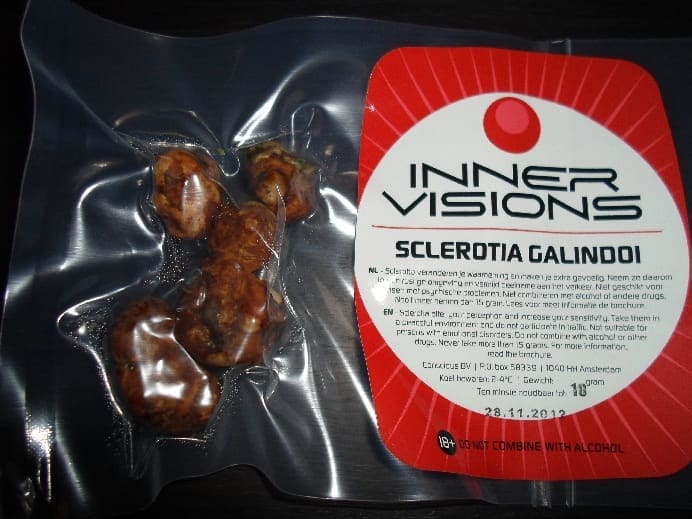
LizaKarma, CC BY-SA 3.0 — Wikimedia Commons (P. galindoi sclerotia; P. atlantis morphologically similar)
Truffle — Atlantis
What are sclerotia?
Magic truffles are sclerotia — hardened underground mycelial masses that the fungus forms to survive drought or other stress. They are a completely different morphological structure from fruiting bodies (mushrooms), though they contain the same active compounds: psilocybin, psilocin, and baeocystin.
Species & Legal Context
Psilocybe atlantis was first formally described from Fulton County, Georgia by Guzmán et al. in 2007 (published in International Journal of Medicinal Mushrooms). In the Netherlands, a 2008 amendment to the Opium Act banned psilocybin mushroom fruiting bodies. Sclerotia were not enumerated in that ban, and have remained legal to sell in Dutch smartshops — a distinction that has held in Dutch courts. In Canada, the full fungal organism — fruiting bodies, sclerotia, and mycelium — falls under Schedule III of the CDSA.
Effects & Character
Sclerotia have higher water content than dried mushrooms — fresh truffles are typically 70–80% water by weight. Because you consume them fresh, the gram-to-psilocybin ratio is very different from dried mushrooms. Pellegrini et al. (2013) measured 59.3–167.8 µg/100 mg fresh weight, equivalent to approximately 0.3–0.8% by dry weight. The Atlantis strain is described as smooth, gently visual, and manageable — a lower-intensity entry point.
Dosing Notes
Fresh truffle weights are not comparable to dried mushroom weights. A 15g dose of fresh Atlantis truffles is roughly equivalent to 1–1.5g of dried P. cubensis at average potency. The calculator uses a dry-weight estimate for truffle in the Atlantis selection — if working with fresh truffles, multiply the calculated gram weight by approximately 10.
Calculate your Truffle Atlantis dose
Open Calculator →Above-Average Potency Strains
~0.85–1.20% psilocybinAlbino A+
Leucistic, Not Albino
"Albino" is the conventional name, but Albino A+ is technically leucistic — it has reduced pigmentation in the fruiting body but still produces dark purple-black spore prints. A true albino would have colourless spores. The distinction matters practically: leucistic strains often retain slightly different compound ratios compared to a hypothetical true albino. The term "albino" persists because it preceded this taxonomic clarity in the cultivation community.
Origin
A+ (also called "Cambodian A+") emerged from the Florida cultivation scene in the 1990s. Albino A+ is a natural leucistic mutation isolated from standard A+. The original A+ was reported by growers active on early mycology forums; like most cultivar histories, the specific individual is unverifiable.
Effects & Character
Faster onset than typical cubensis — often noted at 25–35 minutes rather than the usual 45–60. Vivid open-eye visuals, described as bright and geometric. Body load is reported as lighter than potency would suggest. Some users describe a "quicksilver" quality — energetic rather than sedative. Duration trends slightly shorter than GT at equivalent psilocybin doses.
Dosing Notes
At ~0.95% potency estimate, Albino A+ delivers approximately 25% more psilocybin per gram than Golden Teacher. If your baseline dose is 2.5g GT, start at 2g Albino A+ to stay in equivalent territory. The faster onset means effects arrive before many users expect them — important for set and setting management.
Calculate your Albino A+ dose
Open Calculator →Albino Avery
Character
Albino Avery is distinguished from other leucistic cubensis strains primarily by its reported lighter body-load. Users in creative or social contexts frequently favour it at museum-dose range (1–1.5g) for its clean, cerebral quality without pronounced physical sedation. At higher doses it behaves like any above-average cubensis — the body-load distinction is most apparent below 2.5g.
Effects
Focused and cerebrally oriented, with gentle visuals. Warmth is present but not dominant. Duration aligns with standard cubensis: 4–5 hours. The microdose profile for Albino Avery is particularly favourable — the 50mg capsule format (available in our catalogue) sits well within the sub-perceptual range for most body weights.
Calculate your Albino Avery dose
Open Calculator →Albino Treasure Coast
Origin
The Treasure Coast strain was collected wild from the Treasure Coast region of Florida (around Sebastian Inlet), an area known for year-round wild P. cubensis populations on cattle pasture. Albino Treasure Coast is a leucistic isolation from the standard TC lineage, credited in community records to the same cultivator responsible for developing B+.
Effects & Character
Bright, visual, and described as notably "clean" in the headspace. ATC is considered slightly more potent than its pigmented parent but retains TC's general character: energetic onset, clear plateau, strong visuals relative to dose. It flushes reliably and produces consistent results between batches, which is why it's popular both for personal use and as a consistent catalogue offering.
Calculate your Albino Treasure Coast dose
Open Calculator →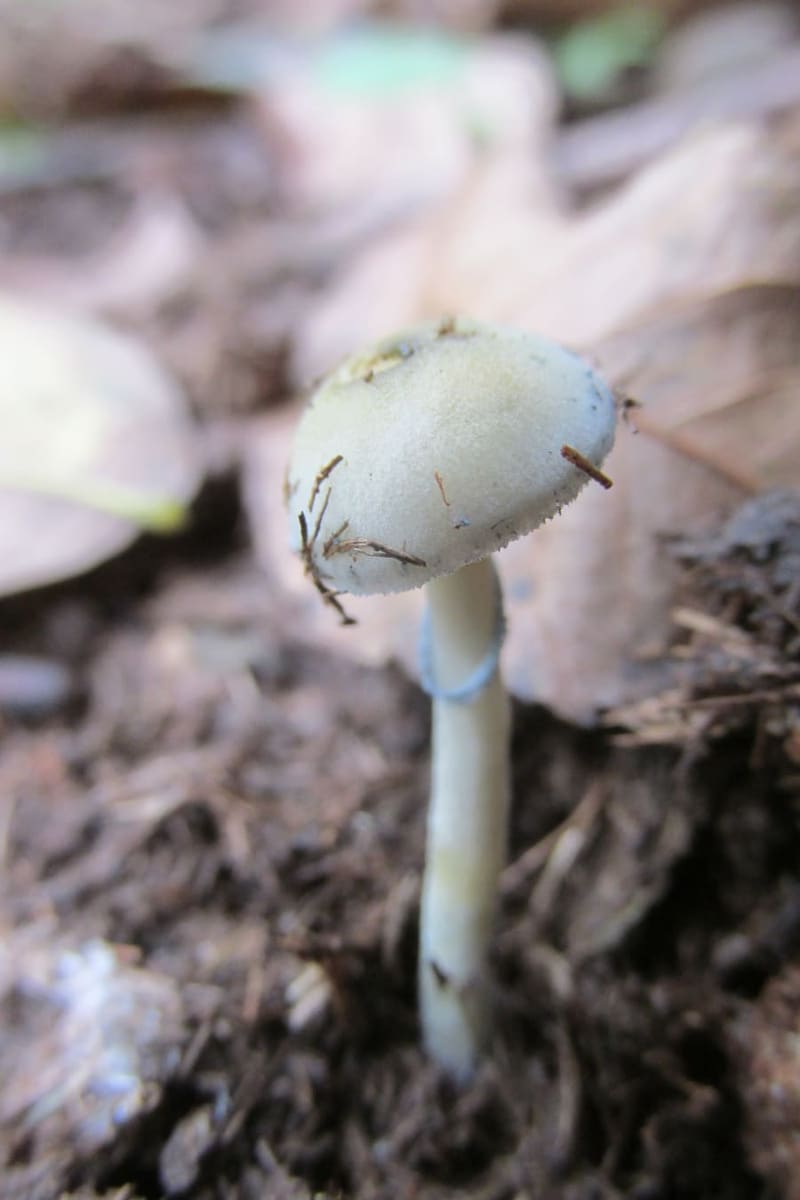
Liz Popich, CC BY-SA 3.0 — Mushroom Observer via Wikimedia Commons (showing characteristic blue bruising)
Blue Meanie
P. cubensis, Not Panaeolus cyanescens
"Blue Meanie" refers to two entirely different fungi. Panaeolus cyanescens (also called Blue Meanie) is a completely separate species — a dung-loving, pan-tropical mushroom 2–3× more potent than typical P. cubensis and with a visually distinct growth habit. The Blue Meanie in this guide and in our catalogue is the P. cubensis cultivar of that name. If you are given Blue Meanie sourced from somewhere other than a known P. cubensis cultivar program, verify the species before dosing.
The Bluing Reaction
Blue Meanie is named for its heavy bluing — the rapid blue-black colour change that occurs when tissue is bruised or cut. A 2020 paper in Angewandte Chemie (Lenz et al.) identified the mechanism: two enzymes (PsiP and PsiL) catalyse the oxidation of psilocin to quinoid oligomers, which appear blue. Importantly, bluing is not a reliable potency indicator — it reflects psilocin oxidation and degradation, not total psilocybin content.
Potency Data
The 2025 PMC review (PMC11856550) measured the P. cubensis Blue Meanie cultivar at 11.8 ± 0.4 mg/g psilocybin — approximately 1.18% and the most precisely documented figure available for this strain from a peer-reviewed source. This places it clearly above GT averages.
Effects & Character
Dense fruiting bodies, dense experience. Body-loading is more pronounced than Golden Teacher — described as "loud," physically present, and euphoric. Visuals are strong relative to dose. The Blue Meanie microdose capsule (50mg) is available for users who want the strain's character at sub-perceptual intensity.
Calculate your Blue Meanie dose
Open Calculator →High-Potency Strains — Handle With Care
~1.0–2.0%+ psilocybinTidal Wave
The 3.82% Record — What It Actually Was
At the Fall 2021 Oakland Hyphae Psilocybin Cup, a sample submitted as "Tidal Wave" tested at 3.82% total tryptamines (2.26% psilocybin + 1.56% psilocin), setting the highest recorded result in Cup history. This record requires significant context: the submitted sample was a non-sporulating Enigma blob mutation — a morphological variant where the mushroom fails to form a standard cap structure and grows as a dense, irregular mass. This mutation is not standard Tidal Wave. The Oakland Hyphae Cup also accepts self-selected "best" submissions from growers, not random samples, meaning results skew toward the upper distribution. Typical Tidal Wave fruiting bodies test in the 1.0–1.4% range.
Genetics & Origin
Tidal Wave is a B+ × Penis Envy hybrid created by a cultivator known as Magic Myco Farm. The hybridisation brings B+'s productive fruiting tendencies into a PE-potency genetic background. The Oakland Hyphae Cup validates the methodology: HPLC analysis at Hyphae Labs, organised by Reggie Harris and mycologist Ian Bollinger.
Effects & Character
Despite hybrid origins, the PE genetics dominate the experience character: cinematic visuals, strong introspective pull, higher chance of ego-boundary dissolution compared to GT at equivalent gram weights. The B+ parentage gives it a warmer emotional tone than pure PE. Duration is full: 5–7 hours at recreational doses.
Dosing Notes
Do not dose Tidal Wave like a classic cultivar. At 1.25% estimate, 2.5g delivers roughly the same psilocybin as 3.5g Golden Teacher. Start at least 20% lower than your usual gram weight when switching to Tidal Wave for the first time.
Calculate your Tidal Wave dose
Open Calculator →Penis Envy
Origin & History
The origin story involves Terence McKenna, who reportedly collected an anomalous high-potency P. cubensis specimen during an Amazon trip around 1971. The sample passed through several hands before reaching mycologist and physician Steven Pollock in Texas, who cultivated and stabilised the phenotype through the late 1970s. Pollock was found murdered in San Antonio on January 31, 1981 — the case remains unsolved. The strain was preserved and eventually spread through the early internet cultivation community, becoming one of the most-discussed strains in psychedelic culture.
Morphology — Why It Looks Like It Does
Penis Envy is immediately identifiable: an extraordinarily thick, club-shaped stem (often 10–15cm, diameter 2–4cm), and a disproportionately small cap that frequently fails to open fully. The cap often remains tightly attached to the stem, which means PE produces poor spore prints — spores never fully drop. This makes PE propagation dependent on tissue culture or partial spore harvests. The cap-closure mechanism is not fully understood at a genetic level; it is an observational phenotype, not an explained mechanism.
Potency — What We Know and Don't
Community Psilocybin Cup data consistently places PE above standard cubensis, often in the 1.0–2.0%+ range for top-performing specimens. A 2022 Leafly analysis of Fall 2022 Cup results found PE-labelled submissions did not uniformly outperform all other strains — the community hypothesis that PE is always 2× GT has been questioned. What is consistent: PE tests significantly above GT average in most controlled submissions. Why remains unknown at the biochemical level — no peer-reviewed study has identified the mechanism linking PE morphology to elevated tryptamine production.
Dosing Notes
This is not a strain for first-time users. Our strongest recommendation: divide your usual dose by 2, minimum. If you typically take 3g of Golden Teacher, start with 1.5g PE. The experience character — described across many accounts as more visual, more intense, and more prone to ego-boundary dissolution — is distinct from classical cubensis at equivalent psilocybin content. At ceremonial or heroic doses, treat PE with the same caution as a 5g Golden Teacher experience.
Calculate your Penis Envy dose
Open Calculator →Albino Penis Envy
The Leucistic PE Variant
Albino Penis Envy is a leucistic mutation of standard PE — reduced pigmentation, pearl-to-white colouration throughout, but still producing dark-coloured spores (confirming it is leucistic, not a true albino). It grows even slower than standard PE, produces even lower yields, and is more contamination-sensitive. Growers who work with APE treat it as a specialist project.
Potency Data
No peer-reviewed head-to-head comparison of APE versus PE exists. Community Cup data places APE regularly in the 1.4–1.8%+ range, above standard PE averages. These figures come from self-selected grower submissions; they represent achievable ceiling rather than typical results. The dosage calculator uses a conservative 1.55% midpoint.
Dosing Notes
APE is in a different category from the rest of this guide. At 1.55% estimated potency, 1g APE equals roughly 2.2g Golden Teacher in psilocybin content. A standard recreational dose in GT terms (2.5–3.5g) maps to 1.1–1.6g APE. This is ceremony-tier territory. The dosage calculator will generate a corrected gram weight — read it, trust it, and plan accordingly.
Calculate your Albino Penis Envy dose
Open Calculator →Wild Psilocybe Species — Not P. cubensis
Distinct species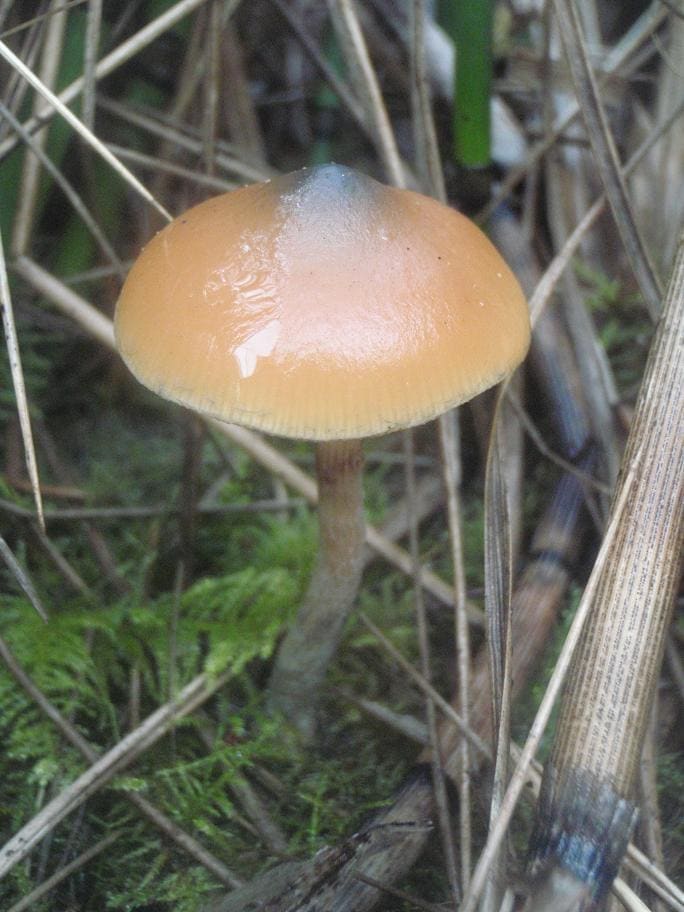
Dan K., CC BY-SA 3.0 — Wikimedia Commons (Pacific County, Washington)
Psilocybe azurescens
Description & Discovery
Psilocybe azurescens is a distinct species — not a cultivar or strain of P. cubensis. It was formally described by Paul Stamets and Jochen Gartz in their 1995 paper "A new caerulescent Psilocybe from the Pacific Coast of northwestern America" (Integration, 6:21–27). The species was named after Stamets' young son Azureus.
Habitat & Range
Native to the Columbia River delta area in Washington and Oregon, growing lignicolously (on wood) — in alder leaf duff, wood chips, and sandy coastal soils. It is a cold-weather fruiter, producing from October through January in the Pacific Northwest. It will not fruit indoors using standard cubensis methods; outdoor wood-chip beds in temperate climates are required for cultivation.
Potency — The Strongest Psilocybe Known
Stamets and Gartz's 1995 analysis measured cultivated P. azurescens at 1.18–1.78% psilocybin, 0.19–0.39% psilocin, and 0.21–0.37% baeocystin by dry weight. Wild specimens measured similarly: 1.20–1.71% psilocybin. These figures make P. azurescens the most potent Psilocybe species documented — significantly above all P. cubensis cultivars. The baeocystin content (a psilocybin analogue) is also notably high; baeocystin's contribution to the overall experience is not well-characterised.
Wood Lover's Paralysis
Wood Lover's Paralysis (WLP) is a distinct adverse effect reported by some users of wood-loving Psilocybe species — azurescens, cyanescens, and subaeruginosa — characterised by temporary leg weakness or full lower-limb paralysis lasting several hours. A 2025 Toxicon study found 42.1% of surveyed users reported WLP, with 80.4% reporting mobility impairment and 48.1% reporting symptoms persisting into the following day. The causative compound has not been identified; aeruginascin has been proposed but not confirmed. WLP does not occur with P. cubensis.
Dosing Notes
At up to 1.78% psilocybin, P. azurescens can be roughly 2–3× more potent than Golden Teacher by gram weight. At the heroic end, 1g azurescens could approximate a 2.5g Golden Teacher experience. The dosage calculator's azurescens selection uses a conservative 1.78% midpoint. If you have never used azurescens, start at 50–60% of your calculated dose. The WLP risk also makes outdoor, immobile settings essential — do not plan to walk distances.
Calculate your P. azurescens dose
Open Calculator →shroomDOSAGE Calculator
Know your dose before you take it.
Select any strain from this guide, enter your weight and experience level, and get a research-calibrated gram weight with full potency context.
Open Dosage Calculator →Session Journal
Track what you take.
The session journal logs strain, dose, preparation method, onset, effects, and notes. Over time it builds your personal potency calibration — more reliable than any reference table.
Open Session Journal →Start low, go slow
All potency tables describe averages. Your individual metabolism, stomach contents, and mental state will shift the outcome. The calculator gives you a starting point — reduce that number by 30% for any unfamiliar strain or new batch.
Two-week minimum
Psilocybin tolerance builds rapidly and decays slowly. Dosing more frequently than every two weeks means each subsequent experience is blunted. The journal helps you track intervals and calibrate your spacing.
Set and setting
At recreational doses and above, environment and intention shape experience more than strain selection. High-potency strains (PE, APE, Tidal Wave, azurescens) are not recommended in unfamiliar or unpredictable settings.
Canadian legal status
Psilocybin mushrooms — fruiting bodies, sclerotia, and mycelium — are Schedule III controlled substances under the Controlled Drugs and Substances Act (CDSA). No recreational exemption exists. Exemptions have been granted for palliative and clinical contexts under Section 56.
Primary sources & citations
- Beug MW, Bigwood J. "Psilocybin and psilocin levels in twenty species from seven genera of wild mushrooms in the Pacific Northwest, U.S.A." J Ethnopharmacol. 1982;5(3):271–285. PMID 7201053.
- Bigwood J, Beug MW. "Variation of psilocybin and psilocin levels with repeated flushes of mature sporocarps of Psilocybe cubensis." J Ethnopharmacol. 1982;5(3):287–291. PMID 7201054.
- Stamets P, Gartz J. "A new caerulescent Psilocybe from the Pacific Coast of northwestern America." Integration. 1995;6:21–27. View via Shroomery taxonomy archive.
- Lenz C, Wick J, Braga D, et al. "Injury-Triggered Blueing Reactions of Psilocybe 'Magic' Mushrooms." Angew Chem Int Ed. 2020;59(4):1450–1454. PMC7004109.
- Pellegrini M, et al. "Magic truffles or Philosopher's stones: a legal way to sell psilocybin?" Drug Test Anal. 2013;5(3):182–185. PMID 22887928.
- "Exploring Psilocybe cubensis Strains: Cultivation Techniques, Psychoactive Compounds, Genetics and Research Gaps." PMC. 2025. PMC11856550.
- "Wood-lover paralysis: Describing a toxidrome with symptoms of weakness caused by some lignicolous 'wood-loving' Psilocybe mushrooms." Toxicon. 2025. doi:10.1016/j.toxicon.2025.108015.
- Oakland Hyphae Psilocybin Cup 2021 (Fall). HPLC analysis by Hyphae Labs. Organised by Reggie Harris and Ian Bollinger. Overview via Inverse. Note: submissions are self-selected; results are not population-representative.
- Guzmán G, et al. "New species of Psilocybe from Georgia (U.S.A.)." Int J Med Mushrooms. 2007 — establishing P. atlantis.
- Johnson MW, et al. "Pilot study of the 5-HT2AR agonist psilocybin in the treatment of tobacco addiction." J Psychopharmacol. 2014;28(11):983–992. — clinical dose context.